
“What we are hurtling toward is a world demarcated into fortified Green Zones for the super-rich, Red Zones for everyone else — and black sites for whoever doesn’t cooperate. Europe, Australia, and North America are erecting increasingly elaborate (and privatized) border fortresses to seal themselves off from people fleeing for their lives. Fleeing, quite often, as a direct result of forces unleashed primarily by those fortressed continents, whether predatory trade deals, wars, or ecological disasters intensified by climate change.” (Naomi Klein, The Intercept, June 10, 2017)
While I was writing this article, I came across an adapted excerpt by Naomi Klein’s new book No Is Not Enough: Resisting Trump’s Shock Politics and Winning the World We Need (2017). As I read it I was touched by the paragraph that I quoted above. I noticed that Klein’s words began to stimulate my imagination; drifting my focus away from her text to a stream of images that flashed in my head showing me a place I knew well.
I couldn’t help but think that Naomi Klein’s description of “black sites for whoever doesn’t cooperate” represented Palestinian refugee camps in Lebanon; one in particular that fits her description exactly is the Ain al-Hilweh, a camp located in the south of Lebanon.
The Ain al-Hilweh refugee camp, inhabited by 120,000 people, is situated within Lebanon’s third largest city, Saida. Known locally as the capital of the South, as one enters Saida from its main boulevard, one sees clean streets, wide sidewalks, luxurious shopping malls, restaurants, car dealerships, and luxury apartment buildings. Here, in this section of this tiny Mediterranean city, one keenly feels the affluence and exclusivity of what Naomi Klein above calls the “Green Zone.” However, just less than one kilometer away from the glitzy facades, the road becomes narrow and dotted with potholes. Then, as one ventures through side roads, the vibrant colors turn into layered shades of grey. The streets are adorned with heaps of litter and trash bags. Apartment buildings sprout up randomly, indifferently violating municipal regulations for urban constructions. Though these affordable residential boxes are not entirely unwelcoming, they still lack the shine and functionality of the luxury buildings towering over them from the boulevard. This stretch of concrete is where the masses are condensed.
In all of Lebanon’s cities, the proximity between the haves and have-nots is a constant reminder of the injustice that separates these two social groups. But in Saida, Ain al-Hilweh constitutes another layer, only two minutes beyond the masses in their “Red Zone.” The inhabitants are forced to pass through checkpoints to enter and exit the camp, where they are subject to ID checks, strip searches, and random arrests and interrogations.
Fortress Europe, Proxy Borders ///
During the summer of 2015, a number of Palestinians from Ain al- Hilweh, joined by a few other Palestinians from different camps, were arrested by the Lebanese Navy. After their boat had made it a few nautical miles past the northern Lebanese city of Tripoli, setting course for Turkey, the escapees were surrounded by Lebanese naval vessels and were towed back to Lebanon. One year before, in September 2014, 107 people, composed of 99 Palestinians and eight Syrians, had hopped into a smuggling boat that promised them a runaway voyage to Italy. The Lebanese smuggler in charge demanded $6,000 per adult and $900 for children under ten. After the boat was captured by the navy, the Palestinians on board were jailed for three months without trial, accused of fleeing Lebanon illegally. All 99 of them had lived in Ain al-Hilweh.
Due to the harsh conditions that these Palestinian refugees were subjected to while in jail, demonstrators tirelessly appealed to Lebanese lawyers to come to their defense and fight for their release. As one Palestinian civil-rights activist then told me, “In Lebanon we are forced to live in open-air prisons and Lebanese people accuse us of being the source of everything that goes wrong in their country. We are constantly reminded that we are a burden. So how come when we try to run away and leave Lebanon for good the Lebanese security hunt us down and force us back to this place? I don’t get it! Let us go away — no, we are not allowed. Let us live in Lebanon with dignity and equality — no, we are not allowed. Are we supposed to die in silence inside our camps?”
These and similar incidents were initial indicators that Lebanon was actively working to protect “Fortress Europe.” And as the news suggests, this client relationship has only intensified. At a meeting between EU and Lebanese security officials last year, EU Ambassador to Lebanon Christina Lassen explained that the EU was “already involved in Lebanon’s security sector through a series of initiatives, including the ‘Integrated Border Management’ project,” (The Daily Star, June 6, 2016). At the same meeting, the head of Lebanese General Security tried to imply that his forces, rather than acting out of self-interest, had an altruistic motive at heart: “In this fierce battle, Lebanon is acting on behalf of the world in general, and Europe in particular, especially in the prevention of illegal migration,” (ibid). This collusion between EU and Lebanese elites gives weight to Klein’s alarming vision of Europe, Australia, and North America “erecting increasingly elaborate (and privatized) border fortresses to seal themselves off from people fleeing for their lives.”
Dying to Escape ///
On May 15, 2011, a large group of Palestinian refugees rushed to the border between Lebanon, Palestine, and the Israeli-occupied Golan Heights in Syria to commemorate the Nakba. A fence was all that stood between them and a squadron of Israeli snipers who did not hesitate to shoot and kill anyone zealous enough to try returning to their proper home. Eventually over fifty thousand people had amassed in a symbolic gesture demonstrating that the land on the other side was where their freedom laid. As this realization dawned upon the young, a spark of defiance arose at the thought of returning to the hardship and confinement of the camps, and they resolved to cross the border despite the risk. Palestinians of all ages on that day were filled with a shared yearning, as they came face to face with the land of their ancestors. While the immensity of the uprisings against dictatorships across the Arab world that year may have made this day on the border seem insignificant by comparison, it gave birth to a resolution which remains in the minds of many to this day: that there is no alternative to the misery of the camps but the right of return.
By the end of the day, people were forced to leave the border, and went back to their camps with bloodstains on their clothes and martyrs to bury. Fifteen Palestinian men had been killed, and many more wounded, after Israeli soldiers opened fire on the protesters. While we sat in the bus on our way back, I was dumfounded by what just happened. I kept wondering about the drive that makes people risking the most precious thing of all, their lives, in order to flee a place that was not even a warzone. Was it because the youth had had their wings clipped over and over again by the confinement and bleakness of the camps? Why had they decided to risk it all and run away from the only place they had ever known?
It is not hard to imagine how the future will look for the recent wave of refugees scattered across Asia and Europe. People from Afghanistan, Yemen, Iraq, Syria, and elsewhere are pushed out of their homes by highly technological conflicts and proxy wars that don’t seem to have any end in sight. These people likely face the same fate as Palestinian brethren who have been forcefully displaced and relocated in refugee camps since 1948, when a predator state called Israel began occupying their lands.
Inside the camp, aid and handouts, whether by the United Nations Relief and Works Agency (UNRWA) or local and international NGOs, have about the same efficacy as a Band-Aid on a bullet wound. The camp’s social well-being degrades by the minute. Networks of local women’s associations, doctors, engineers, and other initiatives are daily stopgaps, triaging wounds while hoping not to crack under the immense pressure created by the need to do more despite the total lack of resources.
Dystopia Sustained by Misrepresentation ///
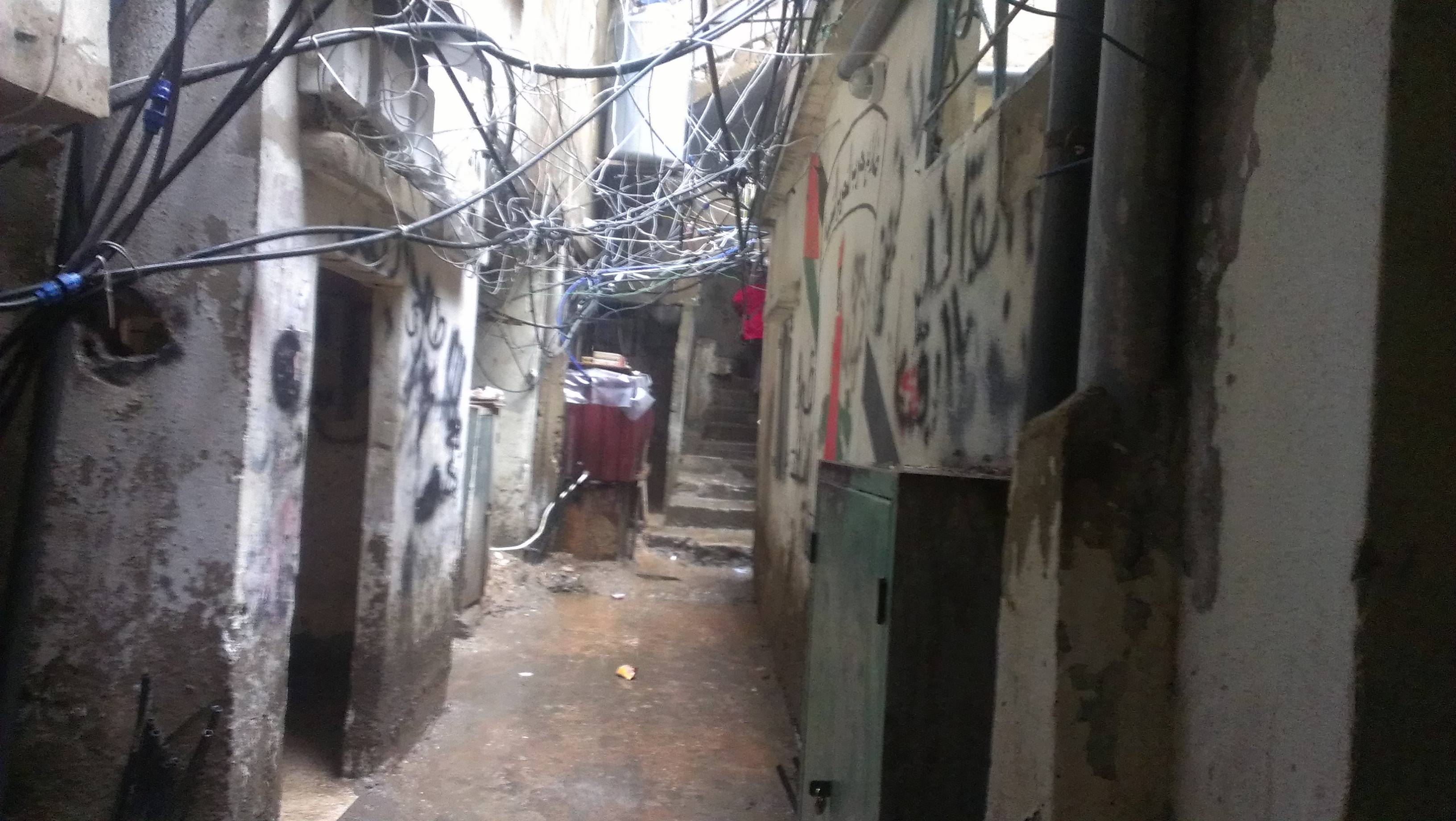
Ain al-Hilweh is a space that produces vicious circumstances, which drive people to contemplate radical solutions; anything is worth transcending the constant, soul-crushing oppression of daily life there. While it is the largest Palestinian refugee camp in Lebanon, comprising over 120,000 people, Ain al-Hilweh is stuffed into only 0.8 square kilometers. Inside this dystopia people are pickled into makeshift buildings stacked one against the other, able to navigate the camp only by way of a maze of narrow alleyways. In 1982, during the Israeli invasion of Lebanon, the entire camp was destroyed by Israeli bombardment. After the Israeli military had leveled the buildings and kidnapped or executed most of the men, the camp had to be rebuilt from scratch by the women returning after Israel’s withdrawal further to the South. Earlier this year, an additional repressive structure was added to further choke the camp. A grey concrete wall was erected around the camp at the behest of the Lebanese state — which for a country supposedly at odds ideologically with its neighbor to the south, seems to share many characteristics with the apartheid wall built by the Israeli government in Palestine. The construction contract for the wall was awarded to a private company owned by a prominent Lebanese politician and paid for by the Lebanese state, is another method deployed to enhance the restriction of bodies in Ain al- Hilweh. To the Palestinians who found it sprouting outside their windows, this brutal wall symbolized the trouble to come.
That 120,000 people have to carry on the essential daily functions of life within the camp is simply invisible to the general consciousness of Lebanon. The first time I went to Ain al-Hilweh, I was twelve and Lebanon had just gotten out of a fifteen-year-long civil war. Back then, the wretchedness of the camp was indistinguishable to me from the rest of Lebanon. I was working as an assistant for a cheese merchant, who had five hundred kilos of cheese that had long since passed its expiration date and was quickly turning green and moldy. The merchant decided that his company was not going to throw the cheese away and lose money, but instead that it would cut the price and sell it in Ain al-Hilweh. Because, as the merchant had put it back then, “Palestinians will eat anything. Go and sell it for half the price. We’ll say its fancy European cheese.”
The second time I went to Ain al-Hilweh was in 2008. I was working as a fixer and translator for foreign journalists. That was when foreign journalists in Lebanon were going to Palestinian refugee camps looking to sensationalize a story and sell it to their first-world audience — today, they go to Syria. A book called Everyday Jihad (Bernard Rougier, 2009) would surface soon after and produce a Western cadre of self-declared “jihadi experts.” The book reduced the suffering and sense of betrayal of Palestinians from Ain al-Hilweh to a narrow reactivity and an exaggerated crudeness perfectly tailored to the rhetoric of the “War on Terror.” One day during that time I found myself working with an American journalist who described himself as a “war reporter” and a “Middle East politics and security expert” — despite having never bothered to learn to speak the language, let alone understand the culture. This “war reporter” had been embedded with the invading American army in Iraq for so long that he seemed to parrot the chauvinism and aggressiveness of a common soldier. He would walk around the camp with a giant telephoto camera hanging off of each shoulder, like some bewildered cowboy in a modern Western. He’d insist on going to Ain al-Hilweh just to wait around outside the main mosque. Sitting on the adjacent street during Friday prayers, he would point at every bearded man as a “possible jihadi,” and since this “expert” didn’t speak the language, he was ordering me as his interpreter to “Go talk to that Salafi. Find out where he was fighting in Iraq.” If I hesitated, he would shout toward the man “As-salamu alaykum,” followed by “Shako mako” (Iraqi slang for “What’s up”), the only phrases he had managed to learn in all his years in the region. Any snarls directed at us in response were taken as a sign, for this journalist, that the offended party was “definitely an Al-Qaeda fighter.”
One Friday, as I looked around me and took in the dystopic atmosphere of the camp, I remembered my first trip when I was twelve and I remarked that as Lebanon has been rebuilt following the massive destruction wrought by its civil war, Ain al-Hilweh was allowed to descend deeper into decay: the densely packed concrete buildings made it impossible to see the sun, there was more traffic, the population climbed, and public space began to disappear. At one point I asked the journalist I was assigned to why he didn’t want to write about the obviously inhumane conditions Palestinian refugees were subjected to at the camp, and how this was a direct result of their country being occupied. He looked at me, as if I had just said the most irrelevant thing, and answered condescendingly, “They lost the war, Israel won. There is no story here.”
Sanctions vs. Steadfastness ///
Accounts such as the ones produced by this cowboy journalist or Every Day Jihad wrongly portray the camp as a source of “global jihad,” a depiction that blatantly misrepresents daily life in the camp and vilifies its inhabitants. The most dangerous aspect of such a distortion, passed off as common knowledge, is that it deliberately erases from public discourse the oppressiveness of the space and its underlying causes. Consistently ignored is the fact that the occupation of Palestine is the reason there are Palestinian refugees in the first place; which makes it easy to issue dehumanizing reports about arbitrarily embittered Palestinians from Ain al-Hilweh to rest of the world. In the imagination of Western journalists and researchers, the camp is simply a place to “mingle with terrorists” to write career-launching reports that cater to the military-industrial complex and the so-called “War on Terror.” These misrepresentations and fabrications about Ain al-Hilweh are later cited in security reports used by the Lebanese government to qualify for military aid on offer from the United States. Thus the security narrative that rules imaginaries of Western pundits plays a crucial role in transforming Palestinians in Ain al-Hilweh into violent, inhuman subjects who can only be controlled by incarceration.
Security sanctions hit Palestinian bodies from all directions, whether as a result of internal fighting provoked by the foreign manipulation of corrupt leaders in Palestine, or by international proxy conflicts orchestrated by Lebanese politicians to take place inside the invisible theater of the refugee camp. Then there are the socio-economic sanctions, which stunt the progress of one generation after another. These measures are actually the most brutal. Palestinian students who have just graduated from university have to deal with the painful realization that they won’t be able to practice the profession they have spent precious years studying for. After more than six decades of forced displacement, Palestinian refugees in Lebanon are still largely excluded from the formal labor market. As a result of discriminatory laws and biased attitudes, Palestinians are banned from practicing over seventy professions. Finally, there are sanctions with regard to ethnic identity which have to be navigated: being a Palestinian in Lebanon means that the moment one steps outside the camp, one becomes a suspect. Every Palestinian male stopped at a checkpoint by Lebanese soldiers is arrested and held at a police station until they can prove their innocence, which can take weeks. As these sanctions repeat and multiply, the symptoms they are meant to treat only worsen; thus they become more and more brutal over time.
Many boys and girls in the camp with access to information through the Internet know the reasons for their dehumanization. They read, think, and discuss and lament their plight. Most of the time they reach a dead end, for there seems to be no way to escape such an oppressive space in an increasingly hostile hosting environment. Many Palestinians fleeing the current war in Syria came to Ain al-Hilweh for refuge, only to be so appalled by the brutality of life there that they chose to go back to the war they fled from and “die with dignity.” For those who for whatever reason are forced to stay, as their wellbeing deteriorated, these desperate individuals from Syria joined a local trend of giving up to the ultimate form of escape by ending their lives on their own terms and departing from misery.
But not everyone falls into despair. Some endure, and decide to challenge the brutal conditions forced upon them. In Ain al-Hilweh, as in many wretched places, there are some who face reality with a radical steadfastness, and as the sanctions continue to punish them, they grow angrier and more vengeful. They find solace in religious spirituality, lacking the privilege to entertain other worldly ideologies or recreational drugs. They nourish their souls by reading the holy poetic texts from the Quran, and they imagine an afterlife that must be good, because life in the camp, the only one they know, is cruel and unjust. These who harden by the day, facing the reality of the camp, rebel using whatever tools are available to them. And when they lash out against those who profit from their subjugation, they are ridiculed and criminalized. They are portrayed as “jihadis,” brainwashed terrorists. Nobody bothers to learn how they struggle every day just to exist, to preserve a bare minimum of their dignity. They are survivors, who try to hold their community together as they bide their time. They know that their steadfastness is in their DNA: a Palestinian instinct unites them, to hold fast until the day comes when they’ll pack a bag, turn their backs on the camp, and head south to Palestine, the only place they can truly call home.
This was first published on The Funambulist by MOHAMAD-ALI NAYEL: https://thefunambulist.net/articles/ain-el-hilweh-camp-physical-administrative-walls-surrounding-palestinian-refugees-lebanon-mohamad-ali-nayel

 Words Of Action كلمات الفعل
Great article, Mo. Really enjoyed reading it and the last paragraph is really powerful, concise and clear.
Ax
LikeLike