
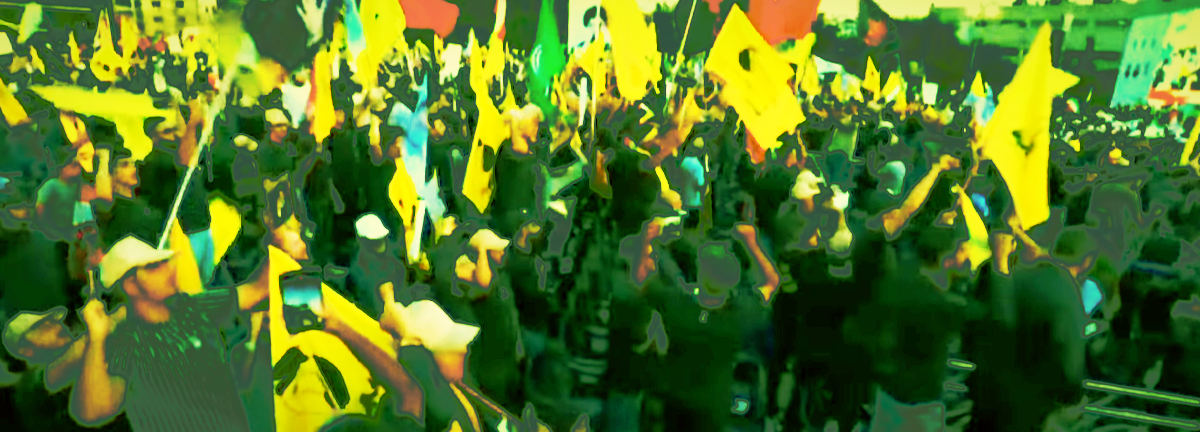
“Once again, the reprisals thus deliberately inflicted on them failed to turn the people against the ‘terrorists’ in their midst. On the contrary, Qana, two-thirds Muslim, one-third Christians, became the tragic symbol of ‘national unity’ restored. Most Lebanese now supported the ‘Islamic resistance’ as never before. Christians as well as Muslims inundated the country’s numerous 24-hour chat shows with enquiries about the location of Hizbullah’s recruitment centres — or how many Katyushas it had fired at Isreal that day, and where they could send money to buy more of them. A wealthy Christian woman who had donated $15,000 for the purpose went on air to say that she had only done so on condition that her Katyushas be expressly directed at Israeli civilians — to let them know that ‘our people in the south’ had as much right to safe life as they. Once, two Hizbullah’s top press officials were visiting a media centre in Ashrafiyah, the heart of Christian Beirut, and, as they got out of their car, an old man, spotting them from across the street, began shouting:
‘Hizbullah, Hizbullah, we are all Hizbullah. We are all behind you. God be with you, you have made us proud.’”
Beware of Small States. David Hirst. P259.
At the start of winter 2007, the political situation in Beirut was rapidly shifting. The political alliance backed by Saudi Arabia and the United States dominated the airwaves with an aggressive discourse against the Lebanese resistance. The cartoonish personalities of the March 14 alliance resorted to deranged scenarios, attempting to contaminate the atmosphere of solidarity that had rallied people around the resistance’s victory in summer 2006. Eighteen years later, today, the same choir continues to disparage the authenticity of the Lebanese resistance.
This story explores the creation of social unrest, or Fitna, within the smallest Arab nation that birthed the most formidable resistance movement against the settler colonial entity – the Jewish state imposed on the region by Western imperialism.
In the beginning
Shortly after the ceasefire in summer 2006, I began working at a new job as a fixer and translator for foreign journalists. This role ignited a sense of purpose within me. Fixing news was a stark contrast to my previous jobs, allowing me to gain insight into the behind-the-scenes workings of news production. This experience motivated me to pursue literary knowledge.
I also noticed that after the war ended, many people I had volunteered with during the war had taken lucrative jobs with a thing called Non-Governmental Organisations (NGOs). I had never heard of such entities before. In this new social bubble I stumbled upon, I found myself captivated by a visceral reaction. A kind of class resentment triggered my nerves towards these young Lebanese whose parents had spent handsomely on their university education and post-university recreational period. I was 23, and since I quit school at 14, I had been working daily to make a living for myself and my family. This new breed of middle-class Lebanese, who were getting paid big figures for doing very little or nothing, was new to me.
At first, I didn’t understand any of the job titles they spoke about: “democracy training officer,” “conflict resolution coordinator,” “human rights trainer,” and “psychosocial specialists,” among other job titles that sounded mystical.
When I took my first fixing job at the end of summer 2006, I was paid $50 for a day’s work. It struck me as a handsome daily rate, and I figured that if this job was consistent, I could make a living by fixing alone. This would also allow me enough time to learn how to read and write. However, at that moment, I had only worked for one freelance investigative journalist. I needed more time to build a reputation and grow a steady clientele of foreign journalists in order to make a living.
It was a critical moment as I attempted to forge a new life plan while grappling with the new reality brought on by the war. However, I found myself consumed by a bitter cocktail of emotions. I was broke and resentful, watching the NGO kids play a game on easy mode while I had been stuck on hard mode since the beginning.
By the end of February 2007, I decided to get out of my head and look for a job with a monthly salary. In a matter of days, word came back through family connections, and I found a job at a wholesale fast fashion business in the Tarek Jdideh area of Beirut. I accepted the job with a meagre pay of $400 per month, on the condition that if I got a fixing job for a few days, I would take it. The shop was a stone’s throw from the Cola bus stop.
My colleagues at this new job were Hani, a 24-year-old, and Mohammad, an 18-year-old. The three of us worked on the shop floor for the shop owners. During our first days at work, we broke the ice by reminiscing about the details of the war from the previous summer (2006). The memory was still vivid in our minds. During lunch breaks, we would stand on the sidewalk and talk about the prowess of Hizballah’s fighters. We would marvel at how they crushed the waves of Merkava tanks, preventing them from invading the south.
Mahmud, a 21-year-old from the shop next door, would occasionally join us, remarking on how the seemingly invincible Zionist enemy was “weaker than a spider web.” The four of us shared stories of our experiences during the 33-day war. I still vividly recall an incident from the beginning of the war. While sitting in my car on Ramlet al-Bayda waterfront, I saw a flashing light strike the sea. Then, a rising orange ball of fire engulfed an enemy warship. Mesmerised by the spectacle, it looked from a distance as if the fire had spread across the water. This happened while I was listening to Sayyed Hassan Nasrallah on the radio, who calmly announced the successful resistance operation, “watch it while it burns!”
The targeting of the warship was a historic moment we all basked in its glory. This operation demonstrated to us that our resistance had significantly enhanced its defensive capabilities with remarkable precision. As we stood on the sidewalk, the boys boasted by flashing Hizballah’s yellow flag from keychains and displaying Sayyed Hassan Nasrallah’s pictures as screensavers on tiny, pixilated Nokia screens. Whether through 2-bit ringtones or pumping sound systems from cruising cars, the victory song (released by Hizballah’s media department after the war) “Nasrak Haz el-Deny” (your victory shook the world) echoed all around us.
By the early summer days of 2007, I began receiving more fixing jobs as Lebanon returned to the international spotlight. During that summer, attention was diverted to a new crisis caused by an unexpected new player.
The Fateh al-Islam militants had established themselves in various apartments across Tripoli and commenced a training encampment further north at the outskirts of the Nahr al-Bared Palestinian refugee camp. When the militant group began wreaking havoc in Tripoli, local news outlets swiftly blamed the Palestinians for harbouring foreign fighters. These news channels, still funded by the Saudis, the Emirates, and the Americans, set the tone for the outcry against “illegal weapons,” which they interpreted as the Palestinian guns in the camps, primarily targeting the weapons of the resistance defending Lebanon’s southern borders from an Israeli invasion.
However, the Palestinians were acutely aware of the consequences of being framed by the Lebanese for such accusations. To prevent a crisis, the political factions from Naha al-Bared sent a delegation to the government, demanding that the Lebanese authorities remove these foreign militants from the outskirts of their camp. Despite these warnings, the Saudi-American backed government, led by Prime Minister Fouad al-Siniura, ignored their concerns and downplayed their issues.
The Lebanese government took no action against the newly discovered militant group. However, after Fateh al-Islam militants attempted to rob a bank in Tripoli, the government was urged to take action. The group was subsequently raided in their safe apartments in Tripoli. A fierce battle ensued resulting in heavy losses among the Lebanese internal security forces. This prompted a moment of constructed national outrage with demands for revenge against the militant Islamic group and the Palestinians. Subsequently, videos emerged showing the bloody bodies of Lebanese military soldiers shot and killed at a checkpoint on the main road to the Nahr al-Bared camp. This led to the political decision authorising the army to attack the Nahr al-Bared camp.
A new hero emerged on the scene. Like Superman, the Lebanese army was promoted through a paid PR campaign, using clever slogans to exaggerate its powers as the “only protector of the Lebanese people.”
Throughout the summer of 2007, the most prosperous Palestinian refugee camp was indiscriminately bombed in an attempt to eliminate the 300 fighters from Fateh al-Islam. Despite a four-month war, the Lebanese army was unable to enter the camp and defeat the militants. The heavy artillery shelling resulted in the complete destruction of the camp causing mass displacement of the Palestinian refugees.
While working as a fixer at the camp during the war, I witnessed events that contradicted official reports. More than one politician from Tripoli and the north confided in the foreign journalists I was with, stating that militants were brought to the camp to be used as a force against Hezballah, but they had gone out of control.
This was another botched attempt by the Saudi/American March 14 coalition, resulting in yet another brutal mediocrity. The Palestinian refugees of Nahr al-Bared once again paid the price of Lebanese political gambles. However, the March 14 politicians, undeterred, decided to escalate the situation by manufacturing a sectarian Fitna (social strife).
During 2007, particularly after the failed experiment of Fatah al-Islam backfired, Lebanon witnessed disinformation campaigns and psychological operations, just as it does today. These efforts were inspired by Robert Satloff, the executive director of The Washington Institute for Near East Policy. He described this as “constructive instability,” a deliberate U.S. strategy under President George W. Bush aimed at fundamentally reshaping the Middle East. Satloff identified Lebanon as a critical and unique test case for this policy. He argued that the U.S. should leverage a “rare confluence of events and international interests” to push for change, focusing on a persistent and incremental approach. However, it became evident that the policy of “constructive instability,” implemented after the assassination of Prime Minister Rafiq Hariri in 2005 and the empowerment of the March 14 coalition, set the stage for the May 2008 conflict by creating a direct power struggle with the Lebanese resistance movement Hezballah.
This approach was deliberately aggravating sectarian and political divisions within Lebanon. It turned political rivalries into deeper conflicts, aiming to reshape the regional political landscape. During the buildup to the May 7, 2008, pro-US/Saudi March 14 political alliance, which included the Future party led by Saad Hariri, deployed aggressive sectarian language. This language was amplified by (Sunni) Muslim politicians within the alliance and was intended to shift public opinion of this segment of the Lebanese population that had drifted towards the resistance following the 2006 war.
An aggressive plan began by spreading a poisonous political rhetoric that aimed to assassinate the collective spirit celebrating and eulogising the resistance’s victory in the summer of 2006. Their orchestrated discourse sought to delegitimise the victory by blaming the resistance for the infrastructural damage caused by brutal Israeli bombardment. Instead of sharing the fruits of an unprecedented national achievement that placed a bold deterrence equation at the southern border, they decided to kill the resistance. The March 14 oligarchical coalition started by delegitimising the resistance, stripping it of its national character, and accusing it of being an Iranian proxy. They realised that the steadfastness of the resistance was celebrated as a victory over the US’s new Middle East designs. Consequently, in the aftermath of the Nahr al-Bared war, a campaign against “illegitimate weapons” aimed at disarming the resistance was pushed to the forefront of Lebanese politics.
By the end of 2007, the war in the north that had left the camp uninhabitable for its 70,000 residents faded out of the local and international news cycle. The camp was declared a military zone, and its reconstruction and return of its inhabitants were put on hold for years. Politically, it was evident that the war on Nahr al-Bared was a harbinger for the main event: disarming Hezballah.
During the short winter days of 2008, the sectarian Fitna began to take effect. I noticed that some young men who had Sayyed Hassan’s pictures as screensavers and those who had freshly inked tattoos of Hezballah’s fist holding a Kalashnikov were targeted by a shaming sectarian discourse. This discourse played on instinctual fears and anxieties. After the war in 2006, young men from across the country found meaning in Hezballah’s victory. From diverse sectarian backgrounds, people vociferously identified with the resistance as a symbol of national belonging. Many others went on to volunteer with the resistance. This fresh sentiment was born out of the heroic fighting, sacrifice, and steadfastness demonstrated by the resistance during the 33-day war.
Many young men and women were touched by the charisma of Sayyed Hassan Nasrallah, who embodied a much-needed leader figure in Lebanon and beyond. The power of Hezballah was especially accentuated in light of the humiliating images that emerged from Iraq following the American invasion in 2003. The victory of the resistance in Lebanon resonated across the Arab and Islamic world as a shining example of emancipation. Furthermore, many enthusiasts kept reaffirming what they considered a sign of purity to the cause: their respect for Sayyed Hassan, and eulogising his son who was martyred while fighting with the resistance in the late nineties. This was a truth that distinguished the leader of the resistance from the rest of the Lebanese and Arab political leadership.
The “new Middle East” that Israel had attempted to impose militarily was crushed on the border in south Lebanon in summer 2006. However, Condoleezza Rice and her Lebanese political allies refused to give up.
The rapid changes in Lebanon and the wider region following the invasion of Iraq have created new realities, reinforced by new money and an accelerated political agenda. The “new Middle East” doctrine attempted to infiltrate through socio-political instruments, such as soft power tools and NGOs, to reengineer Lebanon’s social fabric. Increasingly, the language of individual human rights spread beyond the Westernised middle-upper classes. International NGOs’ focus on saving individuals based on new identities exacerbated the fractures in a hyper-individualistic society composed of 19 sectarian groups. Since its inception, the Lebanese state failed to produce a model of citizenship; instead, Lebanese individuals and citizens were defined by their sects. In contrast, the victory of the resistance in 2006 became a unifying national factor, rallying people behind a national liberation movement.
During the winter of 2008, while working at the clothing shop in Tarik Jdideh, I noticed how the war on Nahr al-Bared was being repackaged and reframed. Rumours began spreading that Hezballah had fought the “Sunni militants of Fatah al-Islam.” It was claimed that the Lebanese army was not involved in the fighting, but rather Hezballah who went on to kill and torture “Sunni Palestinians.” These mind-boggling tales of a war that had ended two months earlier started gaining ground. These rumours were followed by a dose of highly flammable sectarian fearmongering: the Shia were going to attack.
On slow business days, packs of workers would hang out on the sidewalk outside the shops. Mahmud, who worked at the shop next door, used to join us when his stern boss was away. We sympathised with Mahmud, a short man with a high-pitched voice that sounded as if his vocal cords got stuck between puberty and maturity. We listened to him relate his latest stories about his boss’s fits of anger, leaning on dusty cars and smoking cigarettes with small cups of coffee. Often, we joined Mahmud in comradely raps, talking shit about our bosses before switching to our favourite topics: fast cars, women, politics, and the prices of weapons on the streets.
From the start of 2008 weapons became a recurring topic in our conversations. By mid-March, during a tense political discussion, our argument suddenly heated up. While our opposing views had occasionally led to political bickering, it never escalated to nasty sectarian slurs. In the heat of the moment, Mahmud’s fiery eyes locked onto us. He took a deep breath, puffed out his chest, and boasted, “Me and the guys in my neighbourhood are preparing and getting ready!” His gaze fixed on me. When I sarcastically retorted, “Chill out, bro. You keep talking about getting ready, but what are you getting ready for? And with what?” Mahmud was instantly provoked. My sarcasm stabbed through his enthusiasm. In a fit of machismo, he tucked his hand inside his pants. We all thought for a second that he was about to pull out his penis, but instead, he drew out a small pistol. He flashed it at us with a triumphant smile and squeaked, “With this, we are getting ready!”
Mahmud’s unexpected move left us silent with awe. We stood in a circle, heads bowed, as we watched him tuck the chrome piece back into his pants. My coworker, Mohammad, with his freckled face, was motionless, mesmerised. He kept staring at Mahmud’s crouch before speaking quietly, inquiring if Mahmud could get him one. “How much did it cost you?” he asked. “Can you ask them if they take weekly instalments?”
I made a mental note that the increasing talk about guns had crossed the line from boasting to openly acquiring them. This was a sign that the Fitna was progressing too quickly. The political agitation against the resistance was no longer rhetorical, as demonstrated by this incident. I didn’t expect such a move from Mahmud, whose monthly salary was $300. He lived with his parents, and most of his wage went towards house expenses. This wasn’t the first time we had argued over politics on the sidewalk. Hani and I had made the point that buying guns and ammunition for political reasons from your own money was the most foolish thing to do. We always emphasised that this would make you a pawn in the game of corrupt oligarchic politicians. On the other side, Mahmud and Mohammad (who both lived and worked in Tarik Jdideh) stubbornly challenged us. They claimed that everyone was buying guns and preparing to defend their area from a Shia invasion. They were convinced that an imminent existential threat from a “Shia invasion” was about to happen. Mahmud and Mohammad suddenly became sectarian hotheads. When Mohammad added me to his MSN chat messenger nine months before, I noticed his profile picture was of Hasan Nasrallah holding a Kleshnikov. Ironically, none of us were Shia, but most of our customers and some of our good neighbours and friends were. Hani, who came from northern Syria, wasn’t affected by the Lebanese political-sectarian biases at that time. His political leaning was pro-resistance. He was also empowered by the fact that our political viewpoints were similar in that regard, so he didn’t have to hide his true opinion. He was always treated with suspicion for being Syrian, guilty by association of the assassination of Rafiq Hariri in 2005. In addition, like many young people in Lebanon and across the Arab world, Hani and I were astonished by the resistance of Hezballah and thought that the Zionist entity was the source of evil that kept us divided.
However, by spring 2008, Hassan Nasrallah’s pictures became a taboo. Those who still featured them were lectured and scolded until they deleted the image and replaced it with Rafiq Hariri’s. Those who insisted on showing their support for the leader of the resistance were bullied and shamed by the new Future Party figures who began assuming an air of exaggerated leadership in many neighbourhoods around Beirut.
Around the beginning of 2008, the Future Party began deploying muscular men on the streets and corners of Tarik Jdideh and other areas across west Beirut. These men became known as “Ka’id,” which translates to “leader.” The individualism promoted by the Ka’id was the opposite of the role model figure the resistance had represented. The resistance fighter shone as a disciplined individual who is deeply involved in a political/resistance organisation based on sacrifice and the disregard of individualist short-term interests. The Ka’id, a street influencer before social media, was an agitator who was positioned by the Future Party from above as a unifying presence; a curated model, to convey to their supporters that they could join their party for their own individual short term benefit. The choice of the word “leader” was deliberate. The Ka’id, a charming agitator, was a direct response to entice young men drawn to the charismatic leadership of Sayyed Hassan Nasrallah.
The deployment of street level (Sunni) leaders came with an array of flamboyant nom de guerres on the streets. It was a hasty attempt by the Future Party that saw the need to rebrand itself in light of the success of the party of the resistance following the 2006 war.
Shortly after Mahmud flashed his pistol that day, he begged us not to inform his boss or he’d be beaten up. During this time, the conversation about buying weapons and the “need to get ready” spread throughout the streets. Merchants spent their days huddled inside shops, fidgeting like mating roosters. Dropping their heads and walking in circles, they decried the increasing political tension while reassuring each other that politics wouldn’t affect their cross-sectarian business interests. Outside, most local labourers huddled on the sidewalks exchanging information about the fluctuating prices of bullets RPG shots brand-new American Glocks and Colts smuggled from Iraq and everyone’s favourite the Kalashnikov.
At night when all business was shut, I noticed more men sitting on corners forming what they called a neighbourhood security watch. I remember watching them gather conspiratorially around the new “leader” figure dispatched by the Future party. I was stopped a few times at night by these “neighbourhood security” and asked to show my ID. When I demanded clarification, they claimed to be “the sons of the neighbourhood, protecting the area from strangers.” They even asked if I was “Lebanese” and then if I was “from Beirut,” a nonsensical euphemism for “are you Sunni or Shia.”
The increasing presence of these young vigilantes, parading their rookie security attitude at night, became a nuisance that led to trouble with local residents. Their elders, who lived in Tarik Jdideh and had experienced the rise and fall of the Palestinian resistance headquartered in the Fak’hani neighbourhood until the Israeli invasion in 1982, ridiculed them day and night. These older men, affiliated with various Lebanese political factions who fought alongside the Palestinian resistance and later warred against each other during the Lebanese civil war, knew firsthand what was happening on the streets.
Before the chaos of May 7, 2008, these elders in Tarik Jdideh made numerous attempts to talk sense to the “kids” and dissuade them from being drawn into a miscalculation and “sectarian strife that will burn us all.” More importantly, the civil war generation warned the young that their ignorance and stupidity were allowing them to be exploited by politicians.
It didn’t really matter that they were pawns sacrificed for political gain. For a downtrodden young man suddenly invigorated by the power of holding a pistol, the elders’ wisdom sounded weak and condescending. Street hype offered money, status, guns, police protection and a charismatic leader driving a convertible German whip.
Despite the spread of weapons, elders in some neighbourhoods continued their efforts to disrupt the Future Party’s aggressive mobilisation. However the Future Party’s sectarian-political influence and false promises proved far more powerful than any history lesson from civil war veterans.
In the lead-up to May 7, 2008, the Future Party deployed turbaned regiments on the pulpits of influential mosques particularly in Beirut. The Future TV channel, Future newspaper, al-Sharq Radio and street thugs further cemented the narrative that the Lebanese Shia, backed by Iran, were preparing to invade Sunni areas and unleash pogroms and massacres. While the narrative was exaggerated and somewhat laughable sounding archaic and medieval it effectively conveyed the intended atmosphere of agitation.
Beneath the street hype and March 14 propaganda lies a truth everyone instinctively knows: the Shia are cousins, in-laws, football team members, neighbours, friends, business partners, fellow citizens and Muslim brethren, who sacrificed men, villages, homes and properties to defend Lebanon less than two years ago, will never invade Sunni areas like Tarik Jdideh. It’s a no-brainer.
The flood of cash, fuelled by the intensity of political disinformation, created a hypnotic bubble of sectarian machismo around young men on the streets. This omnipotent propaganda, coupled with the so-called invasion scaremongering, made sense to them. It provided a pretext and a legitimate reason to let loose and act gangster, all while they pocketed some cash. This wild scenario sparked a lust for power and control in otherwise forgotten figures. Revived from slumber, an array of thugs, still reliving the taste of flamboyancy from the anarchy of the civil war, emerged. Hired as experienced captains, these men in their 50s and 60s were tasked with organising the youth on the streets.
These captains weren’t focused on image and acting; they quickly established themselves on street corners offering weapons literacy. Once that was accomplished they began extorting their neighbours who hadn’t requested their protection. Every Saturday shops on the high street paid between $100 and $200 as protection money. For instance a pharmacy paid $200 a retail clothing shop paid $150 and a small grocery store paid $100.
During the winter of 2008, Beirut’s streets were shrouded in a gloomy atmosphere. On the last Sunday of January, tensions reached a breaking point in several Lebanese regions. Protests and security incidents erupted in Dahia (the southern suburbs), Beirut, the South and the Bekaa Valley. Unidentified gunmen reportedly opened fire on protesters who were protesting prolonged power outages in their areas.
On January 27 around 4 pm, residents from Dahia blocked the road between Mar Mikhael Church and Shiyah with burning tyres in protest against the ongoing power outage. The Lebanese army intervened, surrounding the area with armoured vehicles to reopen the road. However, the protesters refused to disperse prompting the army to use force some witnesses described as disproportionate. Amidst the scuffle between soldiers and protesters armed men appeared on Ain al-Rummaneh rooftops. Many witnesses noticed the men were carrying binoculars and as protesters pointed them out, the militants began firing, injuring several protesters.
A man died in hospital from his injuries, a representative of the Amal Movement. This sparked widespread protests, spreading from Laylaki road in Dahia to the new and old airport roads. The largest gathering occurred on Mar Elias Street in Beirut. Protest-affected streets were lined with rings of burning tyres and thick smoke. As the anger intensified, representatives from the Amal Movement and Hezballah used loudspeakers to urge people to leave the streets. The wave of rage was successfully contained and the streets gradually returned to normal. Sources from Bahman and Sahel hospitals reported six deaths and over thirty injuries resulting from the Mar Mikhael incident.
By mid-February, while we were unloading a shipment from China containing the spring collection, a breaking news story froze us all. Hajj Imad Moughniah had been assassinated in Damascus. The news of his assassination was a shock, freezing us in our tracks. We had known him as the military commander who led the resistance to victory in summer 2006. He was the shadowy hero who humiliated the American military and killed over 200 marines in a single blow, leading to their withdrawal from Lebanon. He was also the mastermind behind the resistance operations in south Lebanon, forcing the Israeli army to withdraw from the land they had occupied for 18 years without negotiation. However, once the news of his assassination was confirmed, we began to learn more about this larger-than-life national hero.
That February afternoon was shrouded in grim low clouds that quickly turned into showers. By 3 o’clock an ominous gloom blanketed Beirut and the streets emptied. We halted unpacking the new shipment and spent the rest of the day watching the news in silence. Mohammad frowned his movements jittery as he fidgeted with his hands. When we stepped outside to smoke a cigarette he said, “Put everything else aside for a moment. Hajj Imad was a true fighter and a treasure to the resistance. I’m shaken by his loss.” He choked on his words avoiding eye contact as his eyes glistened. I nodded in agreement, unsure of what to say. We finished our cigarettes in silence and returned to the shop.
The martyrdom of Hajj Imad came as a reminder that our main enemy is always lurking in the darkness waiting to pounce on us and kill us whenever they saw an opportunity. The news about Hajj Imad’s martyrdom had the potential to damp down the tense atmosphere that gripped Lebanon and open up the doors of reconciliation. But the American/Saudi death machine was working the airwaves in full swing spreading poison and pushing for Fitna disrupting the grief.
Youth’s raw emotions were easily swayed by money and fear. A toxic political discourse exploited their subconscious drives, promoting fantasies of power. Media fabrication of a specific Sunni victimisation and the rise of a new leader figure, modelled after young billionaire Saad Hariri, on the streets, were deliberate social engineering attempts to mobilise youth enthusiasm behind defined sectarian political lines.
PR companies created a new breed of street influencers. These influencers arrived at night to corners in brand new cars sporting designer shades and a chiselled physique, fresh from the gym. Clad in the latest fashion, they boasted about the opportunities available to those who demonstrated seriousness and loyalty. They constantly emphasised the need to be prepared for the perceived threat posed by the growing influence of Shia. The Ka’id, once a street-smart hustler struggling to make ends meet, became the living embodiment of success. His rapid transformation after joining the Future Party was enough to convince others of his newfound fortune.
By spring 2008, the streets buzzed with rambunctious energy. Street level guides from the Future Party offered unemployed or underpaid individuals social responsibilities like protecting Beirut and the sect, following orders and receiving a monthly stipend.
They also offered bureaucratic favouritism and small perks like cell phone recharge cards and free petrol for cars and scooters. As the numbers of recruits grew on the streets, a headquarters was established. A five-storey building in the Fak’hani neighbourhood was taken over by Future Security. This headquarters disguised itself as a private security company and became a hub for Future Party manpower in Tarik Jdeedi. The building in the Fak’hani area boasted security measures that gave it the appearance of a military barracks. It resembled a fortress, complete with checkpoints and barbed wire surrounding its perimeter.
Towards the end of March 2008, open tabs of Shawarma sandwiches from local restaurants fuelled the muscle on the streets. The agitation rhetoric intensified, now calling for “immunising the Sunnis against the Shia takeover of Lebanon.” This idea expanded, placing the responsibility of protecting Lebanon on the shoulders of the Sunnis. It’s as if the language was designed to deflect attention from the fact that it was Hezballah and the Shia of the south who truly sacrificed themselves to safeguard the country and defend its borders and sovereignty.
By mid-April 2008, the air in Tarik Jdideh was thick with an impending sense of doom. On the streets, the foot soldiers grew restless and paranoid, constantly reminding everyone they were prepared for an imminent all-out Shia attack. Furthermore, March 14 leaders began renting homes in the safer mountain areas, suggesting that many were aware of the approaching confrontation.
“The Shia are going to invade any minute” became a street motto, echoing with each RPG fired into the empty space of Horsh Beirut park. Signs of escalating violence were evident on Fridays after prayer. From mid-April to May 7th, Qasqas neighbourhood in Tarik Jdideh and Sheyah/Tayouneh neighbourhoods in Dahia exchanged RPG shots in the air. The rockets exploded above the cauliflower-shaped pine trees of Horsh Beirut and the matchsticks building of the densely populated Sabra and Shatila refugee camp, which separated the two areas.
Towards the end of April Mahmud visited me with his friend a 19-year-old gun dealer. He’d recently started his business in response to the market surge in demand. I’d arranged the interview through Mahmud who convinced his friend it was safe to speak to me. It was around 7:30 pm just half an hour before closing time. Both our bosses had gone home by six and I’d dismissed Mohammad and Hani shortly after. They looked at me questioning but they didn’t hesitate to go home early.
We had the shop to ourselves. When Mahmud introduced us I was surprised by how young the gun dealer looked. He appeared to be 16. His face was still in its pre-puberty phase with no sign of a beard dotting his smooth brown skin. His skeletal frame suggested he was on the cusp of growing taller. His handshake was weak and lukewarm. However, when he spoke his deep voice resonated with a Palestinian accent. Initially, I looked suspiciously at Mahmud, wondering if he was faking his source. But soon after our introduction, I was impressed by the dealer’s entrepreneurial self-confidence.
I asked him about business and he grinned, saying it was booming with everyone wanting a piece. He fixed his smile and glanced at Mahmud before admitting, “I can’t keep up with the demand.” I shot him a sceptical look and asked if he had any samples. He assured me he had some and started pulling out a piece he’d hidden under his jeans. Then he reached into his shirt under his arm and drew another pistol. Finally, from his ankle, he pulled out a small-calibre handgun. He laid them all out on the table. The chrome piece from his ankle was an old manual model, “this one’s $400.” The automatic from under his arm was a Czechoslovakian model with wood nobs, and he was selling it for $800. He offered to lower the price if I was interested. He confirmed what I’d heard on the street: Kalashnikov bullets were selling for $1 each, and the Kalashnikov itself, which had been worth $50 just a day before Syrian security forces withdrew in 2005, was now going for $1200. It had also become difficult to get hold of one recently. He explained that he could get a Kalashnikov but it had to be pre-ordered.
Musa, the young dealer, informed us that there’s a high demand for Glocks and Colts. He particularly emphasised that these brand-new American items smuggled from Iraq and sold in Lebanon for up to $5000 each. I was genuinely shocked; who would pay $5000 for a handgun? Musa explained that Colt prices had stabilised in the last month but he believes they’ll rise further as the situation escalates. Indeed, they did. On Monday May 5th, when the American/Saudi puppet Prime Minister Siniura decided to dismantle the resistance’s telecommunications network, many Glocks and Colts were sold for $10,000 a piece. Their price then increased to $12,000 on Tuesday and people continued to buy them.
When I asked Musa about his clients and whether he sold weapons to ordinary civilians or Future party figures, he explained that “normal people were buying weapons with their own money.” He continued, saying he had “several men coming to me with their wives’ gold and jewellery, bartering it for weapons and ammunition.” He then remarked that “the Future won’t buy directly from me. They told their supporters to buy their own and promised that on the big day there will be storages full of weapons and ammunition. Each person who bought guns and ammo on their own will be compensated accordingly.” Mahmud chimed in excitedly, “They promised us storages full of weapons that will open when the battle starts.” Checking his watch, Musa then asked me which piece I wanted. I explained that I just wanted an idea about prices for now. He began packing his merchandise and advised us before leaving, “By God, I know men who sold their cars and others who mortgaged their apartments just to buy a piece. You should hurry up before we sell out.”
I was brought here to defend Beirut.
I first noticed him in early April walking back and forth on the street in Tarik Jdideh where I worked. One day he spotted me standing on the pavement outside the shop, eyeing him. When he caught my eye he changed direction and began walking towards me. Reaching my car he slowly circled it, examining the chassis as if he were a body shop expert, searching for signs of past accidents. Finally he approached me to ask about it. He looked at the for sale cardboard on the dashboard and asked, “Is it for sale?”
Ahmad hailed from the northern Akkar region and lived in Tripoli’s poorest neighbourhood. During our second meeting, I let him sit in the car to examine the leather interior and he was captivated by the sound system. I knew he was hooked so I gave him a cigarette and he began recounting his journey to Beirut.
He was one of many young men bused in from the north and placed in apartments around the capital. They were told to stay put and were told they’d been brought there “to defend Beirut.” This euphemism then simply meant defending the Sunnis of Beirut as if the capital itself belonged solely to one sect.
During the warm spring days of April, my black 1992 Toyota Supra became a source of fascination for Ahmad. The maintenance of the turbocharged engine became a significant financial strain on me and I eventually realised I didn’t need a car in Beirut. This is how I met Ahmad. After our initial encounter he would show up to look at my car every other day, inspecting it and pleading with me not to sell it. He asked me to wait for him until he received his payment. He kept assuring me that he’d make me an offer once the people who brought him and his friends to Beirut paid them their due.
Ahmad’s northern sincerity and youthful naivety led him to constantly remind us that he was “here to protect us”. His opening line whenever he saw us hanging out on the pavement was “What’s up cousin I’m here to protect you”. When I sarcastically replied one day “we’re good we don’t need protection” he blushed and murmured that he doesn’t understand why he was in Beirut.
Over time, the cheerful young man from the north became a familiar presence in our lives. During slow business days, Ahmad began joining us regularly, which seemed to alleviate his growing boredom and sense of isolation from apartment life and waiting. He expressed his frustration with shawarma sandwiches and his longing for his mother’s cooking. It was on that corner of the sidewalk where we lit cigarettes, sipped juice and enjoyed small cups of coffee that Ahmad began sharing his thoughts and motivations for joining the Future Party and pledging to “protect Beirut.” At 21, Ahmad had never been to Beirut before. He frequently regurgitated Future Party propaganda, discussing “existential concerns for the sect” and the need for vigilance. His words resonated with the growing excitement and agitation among young men in Tarik Jdideh at the time.
Every time Ahmed visited, he’d ask me how much I wanted for my car and attempt to bargain. On the last Friday of April, he arrived shortly after prayers. I noticed him approaching the street and, upon seeing me standing by my car, he began waving his hands in jubilant celebration. I was in a foul mood, chain-smoking on the pavement. I needed to sell my car and buy a scooter as soon as possible. I wasn’t in the mood for Ahmad’s platitudes about Sunni protection. However, when he reached me, his voice boomed, “Give me the keys to this beauty. My cousin, I finally got paid!” I wasn’t impressed.
Seeing my cold reaction, he pulled out a stack of cash and shoved it towards me. “Here, if you don’t believe me. I’m serious this time. Count it and sell me your car.” I took the money and counted it. To my surprise, he had only half the amount I’d offered. I said, “This is only a thousand dollars.” We had agreed on two thousand, this deal wouldn’t work. He became upset and his chubby face fell in disappointment. His cheeks and forehead glowed amber-red as he spoke quickly and angrily, pleading with me while cursing the Future Party. “They broke their promise. I was supposed to get two months’ worth but they only paid me half.”
My desperation, coupled with his insistence, softened my resolve. I handed him the key and pocketed the money he offered. He got in the car and drove off. After work, I went to buy a scooter.
On May 1st 2008, I was chatting with a Palestinian friend about the dangerous political situation unfolding in Beirut. It was a sunny Labour Day, with a pure blue dome of sky above the sea. We sipped coffee and blew smoke on Ain Mraysi waterfront while facing a calm Mediterranean. Behind us, the whole city was commemorating Labour Day with marches and protests.
My friend struggled to process the distressing news about Palestinian refugees in the Shatila and Sabra camps. He predicted another intense Lebanese moment and assured me the Palestinians would avoid it. His reassurance, more for himself than me, focused on downplaying the news I shared with him: Palestinian men were being recruited by the Future Party as cannon fodder. He dismissed it by saying even if true the number wouldn’t exceed a handful. Then he admitted regretfully any number would suffice for the Lebanese media to blame us. Before we left he said, “May God curse these circumstances that forced a miserable person in the camps to sell himself for crumbs.”
Riding behind him on his motorcycle, we drove around the city. Thousands of protestors lined the streets demanding a higher minimum wage and improved labour conditions from the government. The agitation during Labour Day protests felt like the surface of a much larger issue the government was careening towards.
Sectarian Fitna is far more damaging than actual fighting.
On May 5th, the government decided to dismantle the private telecommunications network used by the resistance. This deliberate move only served the Zionists and was intended to provoke the resistance. I recall seeing a poster on my way to work, hanging on the side of Spears Street next to Barbar Restaurant. It featured the image of Sayyed Hassan Nasrallah and a quote from him: “The hand that reaches the arms of the resistance will be severed.” The atmosphere was charged with signs of an imminent explosion.
On May 7, 2008, a general strike and protests were called for by the Labour Union. It was also the height of political antagonism and sectarian sedition orchestrated by the March 14 coalition. Their strategy, simplistic in its thinking, was to draw Hezballah and its allies into an internal conflict and then prompt American military intervention.
While enjoying my coffee on the balcony around 11:30, I got a text message from a friend of mine who’s an American journalist. He was writing a book about the aftermath of the US invasion of Iraq and Afghanistan. He said: “Yo, where are you? It seems like nothing’s happening today. Coffee?”
It was a day off from the shop and the sun was shining. I had a fresh notebook ready to document my day on the streets. As I prepared to leave my apartment, I realised I didn’t have a car. I’d bought a motorcycle the day I sold my car to Ahmad. However, the mechanic who promised to register it promptly was taking much longer than anticipated. Meanwhile, I was receiving news that all major roads leading to Beirut were blocked with earth mounds and burning tyres.
Around one pm, my journalist friend texted me again: “We’re in Barbour near Corniche al-Mazraa and things seem tense.”
Having stopped overthinking my transport options, I felt a surge of purpose and grabbed my phone, pen and notebook. I stepped out of the apartment and headed down the street. My destination was Barbour street, I decided to walk from my Sanayeh apartment and sense the pulse on the streets.
The streets lay empty, taxi cars nowhere in sight. The city felt on edge jittery, its uncertainty reflected in the suspicious glances exchanged by passersby during the early hours of May 7. As this unsettling sentiment settled over parts of Beirut people instinctively rushed to their local grocery stores to stock up on bread eggs cheese and anything else they could find.
The streets were littered with signs of unrest, trash bags piled high on corners. Street cats basked luxuriously on the pavements. A thick, heavy air filled with dust and fumes from burning tyres coated the atmosphere. The Labour Union strike had paralysed the daily hustle and bustle. Waves of angry protests against the government decision, to deprive the resistance of its safe telecommunication network, surged through major roads around the capital. Specific areas of Beirut were gripped by an atmosphere of tension. On such days when sedition pitted two intertwined communities against each other, the city became schizophrenic. In these dire times, the Muslim parts of the city teetered on the brink while the Christian areas exuded a distant, almost foreign normalcy.
As I reached Mar Elias Street, I picked up my pace towards Barbour Street. However, the top of the street coming from Caracon el-Druz was blocked by smothering rubber tyres. Further down the long shopping street, I noticed the turf was divided between rival factions: the Amal Movement and the Future Party. The proximity of these opposing political parties was astonishing.
Arriving at Tutti Frutti, the fresh juice shop, I navigated through the energetic atmosphere centred around this corner. As I walked through the gathering, I brushed shoulders with a group of young men. Their charcoaled, jubilant faces gave them a solid look of pyromaniacs. They were pushing towards the smothering rubber tyres up the street, their hands laden with more tyres hanging around their hips. A whiff of testosterone emitted from all around their charcoaled bodies and stung my nostrils, my heart raced.
I cautiously took in the scene mentally noting and shuffling my way down the street. Halfway there I was stopped at a makeshift checkpoint. Trash dumpsters blocked the street but the sidewalk remained open. Suddenly a boy, no older than twelve, jumped in front of me and ordered me to stop. “Stop! Hey, you! Where do you think you’re going?” I glanced at the little brat and decided to ignore him, continuing my walk. Then I felt the wind from his agitated body as he lunged at me from the side, trying to block my way with his arms wide open.
I ignored him again and began walking away. His screeching voice pierced my ears as he demanded I stop. I instantly recognised this obtrusive child was the spoiled sibling of one of the men on the street. He then shouted for help gesticulating towards the men sitting on the pavement and calling for their attention.
I glanced at the beefy set lounging on the pavement, puffing smoke from a sheesha that sat between them. The little forge-faced child let out high-pitched cries and grabbed my arm, preventing me from moving.
His move triggered my instinctive response system and I was about to slap him. An electrical current surged through my body concentrating a powerful bolt of energy in my right palm. An angry voice roared in my head: who the hell do you think you are? You little piece of shit! How dare you stop me and demand my ID!
However, I noticed the muscle mass on the sidewalk had stopped puffing clouds. Both men seemed interested in me because of the boy’s annoyance. When I introduced myself and asked about the situation, one of them stood up from his chair. I quickly glanced at the miniature Kalashnikov he held in his lap before it was placed on the chair behind him. After scrutinising my appearance, he threw an unhappy look at the boy who had stopped me. He then spoke lazily waving his hand at me: “Come on just let him look at your ID.” I swallowed my anger and silenced the outraged voices in my head. With a shaking hand, I pulled out my ID. The boy wiped tears from his eyes and flashed a yellow, acidic smile as he glanced at the card without reading it. He then moved aside and let me pass: “Now you can go.”
I dropped my head and walked away cursing that little piece of nuisance. My whole being trembled; it shook me more than I expected. The idea of being stopped by a boy not much taller than my waist unsettled me. He had decided if I was fit to pass through the neighbourhood I grew up in. While checkpoints weren’t unfamiliar, I grew up in the 80s and watched my father negotiate our way through various ones across the the roads of tiny Lebanon. However, this encounter in 2008 stirred up ghosts from the past and brought a kind of fear I never thought of confronting at 25.
I continued walking down Mar Elias Street, avoiding eye contact with the zealous bare-chested protesters zooming past on scooters. At the end of Mar Elias, I reached the Sakant al-Helow police station but found no police presence in the area. I wasn’t surprised.
However, I noticed a checkpoint right next to the station. Blue Future Party flags hung from the scooters they used to block the road. Another checkpoint! I passed a group of men who gave me intimidating stares but didn’t stop me when I raised my hand and greeted them. Turning left, I began walking down towards Barbour Street.
Barbour Street, another shopping strip branching from Mar Elise, stretches east to the Barbir Bridge. Similar to Mar Elias, the street is lined with tall residential buildings on either side and clothing shops along the sidewalks. At its end lies a secluded area known locally as the Gold Market. On the map, Barbour Street runs parallel to Corniche al-Mazraa Boulevard, cutting through Barbour, Borj Abi Haydar on one side and Tarik Jdideh and the Cola bus stop on the other.
During the Civil War and much of the 1990s, Barbour was a stronghold of the Amal Movement. This was because the movement’s leader Speaker of Parliament Nabih Berri used to live there. However, after Berri moved his residence from Barbour to Ain al-Teni an affluent part of the city his loyal supporters remained strong in Barbour. The area has a mixed demographic and is home to the famous mosque and charity centre Ebad al-Rahman. Just a short distance from the mosque is the St George’s Maronite Cathedral and nearby is the al-Ta’adod basketball arena.
Ten minutes later I was halfway down Barbour Street. I slowed my pace when I spotted the main intersection packed with protesters and filled with the sound of Amal Movement anthems. From my vantage point I could see around fifty mostly young men scattered around the intersection. The rest of the street was empty and quiet.
In the absence of the usual traffic jam, bustling pedestrians and window shoppers, a colourful array of stray cats – black, marble, tabby, black and white – spread out feasting on fresh piles of rubbish. Amidst the chaos, a group of topless teenage boys gathered around a burning rubbish bin, the acrid smell of melting plastic wafting through the air. On the corner sidewalk of the intersection, I spotted two men. One held a walkie-talkie while the other, my friend, took notes. Nearby, two photojournalists – an Iraqi and a Lebanese working for foreign media outlets – listened intently.
At this stage of my journey, my sense of security was intense. Finally connecting with the journalists, I felt a wave of relief. It was as if aligning with this supposedly impartial group of observers granted me an air of neutrality regarding the politics shaping the streets.
Standing amidst the gathered men, I scanned their faces, searching for any familiar faces among the protestors. My intention was to avoid spotting anyone who recognised me and knew I worked in the opposing area across the Mazraa boulevard. It’s a tricky mental exercise in such a small city, especially during these compressed moments, to maintain a position of “neutrality”.
Fixers face a dilemma when working with foreign journalists in their countries’ conflict zones. Given the close-knit nature of these communities, they risk being mistaken for infiltrators. Ironically, being a complete stranger is often less problematic. Foreign journalists are far less prone to paranoia or suspicion in the context of local political rivalries. Foreign journalists are generally suspected of being spies for their countries or Israel. I wasn’t planning to be on one side or another on the day of the confrontation but when I realised my location a creeping paranoia drenched my palms with sweat. I kept thinking about the ties of job and family I had with the opposing side in Tarik Jdideh.
At the main intersectionof Barbour Street, where Corniche al-Mazraa meets Tarik Jdideh, the Lebanese army was deployed to contain the overflow of protesters from both sides. Barbed wire was laid at the end of the streets leading to the other side and five fully equipped soldiers stood behind it. Their sluggish movements and visible tiredness and boredom on their sunburned faces suggested they were exhausted.
Around 3pm, we noticed a silver Cherokee Jeep with tinted windows double parked next to us. The Amal men in charge of the protest dynamics gathered around the windows and spoke to the two men inside. After they dispersed, a journalist I was with approached the men in the Jeep and chatted with them. As he walked back, I noticed a smirk on his face – he’d just obtained exclusive information. He whispered to us, “They’re Hezballah representatives. They’re here to ensure things are under control.”
It was the first sign of Hezballah presence that I saw that day on the streets. The way they sat in their car and coordinated with Amal representatives was an indicator that there was strict planning for this day.
I became a bit fidgety when I noticed some Amal men gathering inside building entrances. They were donning their camo vests and slinging Kalashnikovs from their shoulders, appearing to get ready. They remained waiting inside the entrances, and I knew clashes were imminent.
I walked down the intersection to speak to the Lebanese military soldiers about the situation. I was curious to know what the army would do if things escalated. I saluted the soldier standing behind the barbed wire and introduced myself as a journalist. As a Lebanese citizen, I wanted to ask about the army’s plans to protect us. The soldier replied nonchalantly, “Then go home now!” I then asked why they were deployed between the two areas. He explained that they had received orders to be there and were instructed not to get involved. Their job was to remain neutral and prevent people from crossing over.
At around 3:30, the most eagerly anticipated moment of the day arrived. Suddenly Sayyed Hassan’s voice boomed from the sound system of a car parked right next to us. An instant hush fell over the street as Sayyed Hassan began his speech. His calming words resonated with everyone. People stood attentively around the car, their ears straining to catch every word emanating from the radio. His message was thunderous with defiance, seemingly marking the final call to the other side to retract the government’s decision to sever the resistance special telecommunication network.
Sayyed Hassan Nassrallah addressed the Arab and muslim world emphasising that, “what you are witnessing in Beirut is not a Sunni Shia Fitna.” He then added that, “they always threatened us by the Sunni Shia Fitna. Today I want to say we are no longer anxious about a Sunni Shia Fitna. This issue is over, and this weapon no one should resort to. Today, the battle is not between Sunni people or Shia people nor is it between groups of people who have some Shia or Sunni. Today there is an honourable national resistance project and there is an American project clashing, those who like to be with one side or another are free to be where they want to be. This is the nature of the battle that exists in the country today.” Sayyed Hassan went on saying that “we never used our weapons internally for a coup or to impose a fait-accompli situation. The only time we used our weapons is to defend our weapons.”
The rumble returned to the street almost immediately after the speech concluded. Hyper enthusiastic voices shouted out in jubilation labaik ya Nassrallah (At your service, Nasrallah). From All across the city came echos of celebratory rounds fired in the air piercing the sky. The militants who were gathered inside the building entrance now came out and stood on the sidewalk in anticipation.
The Amel Movement representative standing next to us raised his walkie talkie close to his ear. We saw his face harden after we heard him tell his companion: “a spray of shots was fired at the Future Party office in Noiary area.” The incident occurred a couple of blocks away from us and marked the first exchange of fire which triggered all the fronts across west Beirut.
Like a fireworks on new year’s eve the sound of the battle grew gradually then exponentially all around us. Things moved too fast when we heard individual pistol shots fired at us from the direction of Tarik Jdideh.
The attack from the other side completely flipped the situation. The young men burning rubbish and protesting on the street were swiftly whisked away in buses and minivans. Those left behind were us journalists and about 25 militants armed with Kalashnikovs and RPGs.
While I watched the militants load their guns and take position I kind of envied them. I felt so alienated and weak. I needed to feel that same euphoria emitting from the militants as soon as they emerged with their weapons. Under the pressure of fear and uncertainty I went to check the Lebanese military soldier I was talking to earlier. To my surprise I found him packing the barbed wire that they used to separate both areas. I shouted before I reached him: Hey, what’s the problem man! Where are you going? Who is going to protect the streets?” He looked at me and I instantly saw the terror in his eyes as he quickly brushed me away saying: “we have just received orders to withdraw immediately.” When I got closer to him I raised my voice over the sound of the military truck that came to evacuate him: “then where are you going to deploy in this case?” The soldier was erratic, words came out trembling from his mouth as he was about to drag the ring of barbed wire and leave: “we were ordered to go gather under the Cola bridge and wait for further orders.” When he took his barbed wire and walked away I realised that I was standing in the line of fire exposed to the other side. My body was jolted to attention when I heard a spray of Kalashnikov bullets fired in our direction.
I dashed back and found the journalists and a group of pedestrians who had gathered at a sheltered corner in front of a grocery store. I sprinted towards the gathering. In such panic stricken moments there is a strange vivid feeling that overtakes people. It feels like everyone becomes so focused on protecting themselves that they stop registering any concerns outside their own shell.
Under the grip of adrenaline, my senses heightened. I found a boy, no older than ten, pulling my arm. He was crying and his face was a yellow, fear-stricken mask. I tried to avoid him but he wouldn’t let go. Finally he released my arm and I kept looking at him, trying not to meet his gaze. I watched him try to get the men’s attention but no one noticed him. It was as if he had become invisible. Then he turned and caught my eye. He got closer still crying and said nothing.
A wave of sympathy washed over me. I immediately asked him why he was on the street and why he wasn’t at home. He held up a black plastic bag and explained, “I was buying eggs and cheese when the shooting started. I’m scared and don’t know what to do.” I reached for my phone and asked if he knew his home number. Fortunately, he did. He spoke the numbers from quivering lips. As I dialled, the line went dead almost instantly. The pressure was immense as everyone was calling and the network was collapsing.
I took his hand and headed into the grocery store. Inside, the landline was broken. This made me think if the boy was out here in his flip-flops his house must be nearby. When I asked him to show me the way he brightened and pointed across the street. I told him to hold my hand tight and we dashed across.
As we crossed the street, I asked him which building it was. He simply said, “It’s just up there.” Damn, he’d tricked me. I mustered the courage and told him to hold my hand and walk very close to the wall. We turned the corner and began walking by a whitewashed wall. Halfway up the open street, the boy shouted, “There, up there! This is the building!” We cautiously walked along the wall, we were about ten metres from the entrance to his building. Suddenly, the wall above us started chipping white flakes that fell on us.
Realising we were under fire from the other side, I let go of his hand and urged him to run as fast as he could, telling him not to look back. He slipped off my hand like a little bird and darted towards the entrance. Just as I saw him disappear into the darkness, a barrage of shots hit the wall above me.
Then I heard the whiz of bullets splitting the air above me. I realised they were aiming at me. This realisation hit me like a thunderbolt! I was being shot at from the other side, Tarik Jdideh, where I work and have family and friends. If they had binoculars they could clearly see I’m not a militant! What the hell!
Without thinking, I ducked between cars until I reached the back entrance of the building nearby. I ran and started jumping over walls, desperately searching for an opening to the main street so I could reunite with the journalists. As I leapt over the third wall, I spotted two teenage boys and noticed the charcoal smudges on their faces, indicating they’d been out on the street earlier. Startled by my sudden appearance, they froze as I discovered them huddled between plastic water tanks.
We stood there like two cats in a standoff. I quickly spoke to preempt their fear, “I’m a journalist. I was taking a little boy home who got stuck on the street and I need your help. They shot at me from Tarik Jdideh and I’m here trying to find my way back with the foreign journalists outside on the street.” They looked at me with disbelief. At that moment our sense of security was heightened. I wanted them to believe my true but bizarre story.
One of them seemed a bit on edge and I could tell he was about to panic. Seeing me scrutinise his confusion, he demanded I show them my journalist card as proof. Damn, motherfucker! I wasn’t prepared for this. I was startled by his challenge because I didn’t have a journalist ID! So I pulled out an expired international driving licence. He snatched it from my hand and looked at it upside down. I quickly realised he couldn’t read it. My confidence soared when he looked at my picture and told his friend, “Yeah, that’s him. It says journalist on it.” I seized the moment and asked them to show me the way back to the street. They led me through the concierge room and out onto the street, warning me not to return to where I’d found them. I retorted sarcastically, “Bro, please. As if I casually went and dropped on you like that.” When I reached the street, my journalist friend looked at me and exclaimed, “What the fuck happened to you?” I tried to explain, but my body was shaking violently and words wouldn’t form coherent sentences.
The anticipated big explosion in west Beirut has finally happened. I never imagined I’d be spending it with militants from the Amal Movement. As the battle settled into a sporadic tit-for-tat, we were occasionally invited to photograph them firing RPGs.
Initially, the photojournalists darted around the RPG shooter capturing him from every conceivable angle. Then, a driver and shooter on scooters performed a drive-by shooting. They sprayed shots across Corniche al-Mazeraa from open intersections. After our initial excitement subsided from watching RPGs and drive-by shootings, we began to notice a pattern governing the firepower.
We realised the shooters weren’t targeting anything on the other side but were instead instructed to fire on empty spaces. The RPGs and Kalashnikov rounds landed in an empty parking lot or barely grazed the white walls of tall buildings behind it. This pattern became evident, showing that our side’s shooting wasn’t random but deliberately contained, creating a war-like atmosphere with minimal material damage.
The sporadic shooting from the other side (TJ) was aimed at killing. Their weapons were mostly small calibre pistols and Kalashnikovs. While we heard individual shots from them, they never fired in torrents like the militants on our side did. They didn’t fire any RPGs our way and the intensity of their fire gradually decreased until it completely stopped around 8:30 pm.
When militants on our side noticed the opposing area’s shooting had stopped they too reduced their fire. It was significant that there was no will or orders to cross into the other side and take over their neighbourhoods. This controlled conduct confirmed what I’d told Mahmud a couple of days ago: there would be no invasion.
As the night deepened, sporadic shots echoed from other parts of the city. The Amal militants around us were instructed to hold their fire and retreat to the building entrances. Eventually, the militants grew restless and began requesting permission to fire just one more RPG or drive-by.
The men in the Cherokee Jeep overseeing this corner maintained firm orders and restricted the fire towards the other side. This situation led to boredom among the militants in jeans and t-shirts. One particularly clownish-looking militant slapped a Lebanese photojournalist with us. When I confronted him about the slap, he claimed, “That guy had charisma radiating from him all day and it provoked me. I had to slap him!”
I sought a clearer explanation and asked, “But what did he do to you? Was he taking pictures you didn’t approve of?” He adjusted his spectacles and placed a friendly hand on my shoulder, speaking sincerely, “Look, you’re a good man. I can see it. I look at your face and know I can trust you. However, that man over there had a charisma that provoked me and I had to hit him.” After we smoked a cigarette and discussed the day’s events, he stubbed the butt on the floor and walked away towards his friends. They were equally surprised by his action, they gathered around him and lit a cigarette for him. He then started fixing his Kalashnikov’s sling on his shoulder and returned to Paul. Seeing him head towards the photojournalist, I feared he might shoot him this time so we rushed towards them. To my astonishment, the short bespectacled militant approached Paul, who is much taller with a shiny bald head, and apologised.
That night, darkness descended upon us like a thick black velvet blanket. Streetlights were extinguished and above us, people in their apartments switched off their lights and closed their windows. Beirut seemed even darker than usual. Around 9:30 pm, we realised the battle with Tarik Jdideh was over. Following the militants’ advice, we sat on the tiled floor in one building entrance. Shortly afterwards sandwiches were distributed and we ate while chatting with the resting militants.
One of the Amal commanders was casually chatting with us when suddenly all our attention was drawn to a message on his radio. The other commanders spread out across the city began sharing news from their locations. It was shocking to hear field reports of the swift fall of specific neighbourhoods that had been advertised as Future Party strongholds just days earlier.
The Future Party’s locations were being overrun so quickly that by 9:45 pm the entire west of Beirut had fallen to the March 8 forces.
The big news came when we heard Amal militants on the radio chatting with their comrades deployed in the Clemonso area. They were laughing and joking about surrounding Waldi Jumblat’s palace and capturing his security personnel. They took pride in how Jumblat had requested protection from their leader Nabih Berri, who had secured Jumblat’s withdrawal to the mountains. This news shocked me because just a month before the May 7 events Jumblat had been leading the March 14 assault on the resistance’s telecommunications network. Through speeches and TV appearances, he had become a rabble-rouser, fanning the flames and agitating for this very day.
By 11pm the sporadic shots faded into a cautious calm. Knackered journalists and militants sprawled on the tiled floor of the building entrance. A cold draft seeped into our bones and as the adrenaline finally faded heavy fatigue washed over us.
Slap on the wrist
Shortly after the Fajr Adhan announced the call to prayer, the darkness gradually faded into a soothing blue. Following the rhythm of the final echo from the Adhan, “Prayer is better than sleep,” we rose and found the streets calm and empty.
At the corner, one of the militants had put away his rifle and was sweeping bullets from the pavement with a long broom. The sound of his broom brushing away the remnants of last night’s chaos, the aroma of freshly brewed coffee and a faint hum of Quran playing from a radio somewhere signalled a return to normal after the storm.
The men in the Cherokee jeep sipped their coffee outside their car, looking satisfied. We cautiously moved around the street. The early morning light provided the photojournalists with a chance to capture the aftermath. More militants joined their comrades, sweeping and packing up. It was time to check the damage on the other side.
We strolled down the side street and crossed the corniche al-Mazraa boulevard without looking left or right. There were no cars in sight. However, as soon as we entered the main shopping street Afif al-Teabi in Tarik Jdideh we were surprised by the minimal damage from the battle. The visible damage consisted of bullet holes in the first line of parked cars at the street’s entrance. Shards of broken glass scattered on the sidewalks fell from apartments touched by stray bullets.
As we ventured further into Tarik Jdideh, we passed a few people inspecting their shops and cars. I noticed some of the men I’d known from my job there. I still harboured a grudge from being shot at the previous day. I scrutinised the frowning faces, hoping to find someone who could help me identify the person who shot at me while walking the boy home.
However, I quickly gave up my quest when I noticed the hostility in their long faces and the dejected body language. Their hands were raised as if in surrender, while angry local men moved around silently. Suffocating betrayal choked the words in their throats. Some men moved aimlessly in the street sobbing in silence while others, younger men, looked crushed and defeated beyond repair. One woman, noticing our cameras, began shouting in our direction: “What have we ever done to them to treat us like this? Are we Israel? To shoot at us all night.”
The entire community was shaken but a strange mix of relief and disbelief lingered. One man recounted, “We ran out of the ammo we bought before midnight and were expecting an invasion but it never happened.”
This remark sparked a refrain from men gathering on corners: “They abandoned us. They fooled us.” These men referred to the Future Party street organisers. As time went on more disillusioned men appeared on Tarik Jdideh’s streets. They expressed disbelief at their quick defeat, as if experiencing an anticlimactic chemical comedown after the hype they’d been subjected to the previous month.
I saw my coworker Mohammad walking around looking like he’d just been released from captivity. His bloodshot eyes told me he’d been through something traumatic. I asked him what had happened and where he’d been during the night. He was searching the area as if he’d never seen it before, as if he was seeing his neighbourhood for the first time. He explained that his father had taken his mobile phone and locked him inside their apartment all night, even banning him from going out to the balcony. Mohammad was visibly upset and spoke in a loud voice about how the men had been betrayed, abandoned after the battle had started.
As I ventured deeper into Tarik Jdideh, more stories unfolded. Shortly after the battle commenced, those who had taken advanced positions against the Barbour area ran out of ammunition they had purchased independently. However, when they searched the storages supposedly brimming with guns and ammo, they discovered empty spaces. Furthermore, when they attempted to contact the Future Party leader in Tarik Jdideh, his phone remained off throughout the night. Furthermore, the remaining local organisers vanished as soon as the shooting began.
This prompted many militants to head to the Future Security fortress to replenish their weapons and reinforcements. There they discovered that men bused from Tripoli and Akkar were given wooden batons and left to wander alone in unfamiliar neighbourhoods. Distraught militants from Tarik Jdideh and those who had been bused to Beirut both claimed to have burned down the Future Security building. However, I later learned from someone who worked there that it had been deliberately set ablaze to destroy records of those trained in Jordan and erase payroll details detailing who paid whom.
We left Tarik Jdideh licking its wounds and, seeing no taxis, we trudged back to our apartments in the Ras Beirut area. As soon as we reached Conrich al-Mazraa Boulevard, I spotted the Lebanese army camped under the Cola bridge. The soldiers stretched lazily, appearing well-rested.
Returning home, the streets were eerily quiet and empty. Yellow bulldozers and bobcats diligently worked to remove earth mounds and clear the main roads. Surprised by this scene at such an hour, I noticed a convoy of Bangladeshi trash collectors being transported and deployed across west Beirut. Their mission was to sweep away empty bullet cases and clear the remnants of last night’s events. As we crossed Mar Elias on our way back, I spotted militants emerging from street corners, preparing for their final withdrawal.
It was remarkable that throughout our journey we didn’t encounter any militants from the Future Party. However, we did pass by several abandoned Future Party sites with fresh bullet holes. One (Future Party) medical centre right next to my apartment on Malla Street was situated in an old white building that had been completely burned down. The facade was stained with a massive black charcoal mark stretching from the third-floor windows all the way to the roof. Neighbours told me a sniper was hiding on the third floor and the fire was the result of an RPG shot targeting him.
Upon arriving at my apartment in Sanayeh, I noticed a couple of Amal Movement militants standing in position in an unfinished building next door. After a short break, I returned to the streets and met my friend at the start of Hamra Street, near the Franca Bank.
As we passed the Al-Madina theatre, we noticed a completely different street takeover. The organisation here was vastly different from the militant scenes we’d seen in the last 24 hours.
On both sides of Hamra Street, tactical groups of soldiers in military uniform patrolled silently. Six soldiers per unit, their weapons gleaming clean and tidy. We attempted to speak to the young, fresh-faced soldiers in their early twenties but they remained unresponsive and uninterested. Focused on their mission, these soldiers were unlike those we spent the night with. Operating under strict discipline, they eschewed bravado and show off, creating an impressive spectacle.
We continued walking along the young soldiers harassing them with our questions to confirm that they belonged to Hezballah. None of them spoke to us. Suddenly, our answer arrived when a belly-barrelled man in his fifties, dressed in a grey t-shirt and black cargo pants, was marching towards us.
Before reaching us, he strictly ordered us to stop talking to the soldiers and follow him with a wave of his hand. I knew we’d upset the commander and instantly felt drenched in sweat. I told my friend “we shouldn’t have insisted on speaking to the soldiers.”
Instinctively, I knew these men weren’t the kind of jokers you could casually joke about or outsmart by some witty excuse. He led us to a white Cherokee Jeep and demanded my ID. I immediately explained we’d spent the night in Barbour with their allies and we were journalists. However, he dismissed my pleas.
He only said one thing: “What are you doing here?” in a tone suggesting we shouldn’t be there. He then handed my ID to the man in the mud-stained white Cherokee Jeep. We waited on the sidewalk, and I was shaking and impatient. Unable to calm down, I told the silent commander in front of me about my volunteering experience in the South after the war ended in 2006. This piqued his interest for the first time. He then said we shouldn’t be here and I explained again that I was a journalist. I introduced my colleague, an American journalist, but the commander was uninterested in him.
After some time, the man in the Cherokee called for the Hajj and returned my ID. The driver displayed something on his laptop screen and they both nodded. The Hajj then walked back to us and handed me my ID card. He then put on a serious fatherly face and urgently asked us to leave and walk away immediately. We tried to converse or extract a quote from him to understand why Hezballah hadn’t deployed like they did here elsewhere in the city. However, the Hajj dismissed us and repeatedly urged us to leave.
Leaving Hamra Street, we discovered that the Future TV building in the Roshe area had been set ablaze by employees attempting to destroy some of their archives. However, their actions caused far greater damage to the entire structure. Shortly afterwards, the SSNP militants took control of the TV station and decorated the offices with pictures of President Bashar al-Assad.
The Future newspaper was surrounded by Hezballah fighters and subsequently handed over to the Lebanese military. Hezballah and its allies employed this tactic in numerous locations they seized and subsequently transferred to the Lebanese Armed Forces.
The following day we travelled to Mount Lebanon to assess the situation. We had heard of ongoing clashes between Druze militants and Hezballah fighters. Before reaching Kahali, we were halted by a flying checkpoint manned by Druze Sheikhs dressed in their traditional attire: black sherwal, black vest and white head cap.
They aggressively demanded we get out of the car. When we did I told the militants we were journalists. They asked about my sect and where I was from. As I explained our situation, our attention was drawn to a short, erratic militant in blue jeans and a black t-shirt. He held a G-3 WWII rifle, pointing it as he marched towards one of the journalists, the tallest most muscular man among us. I shouted at the militant, explaining to him that this is a foreign journalist and he does not understand Arabic. However, the Druze militant now faced the journalist, looking up defiantly as his gun pointed at his body. He demanded to know the journalist’s origins. When the journalist produced his American passport the puffed-up man instantly deflated and the atmosphere eased.
Now the grim militant turned to me and began interrogating me. He demanded I reveal my whereabouts. I challenged him by saying I was Lebanese like him, from Lebanon. This provoked him and seeing him lose his composure, I quickly told him what he wanted to hear. Then they asked us what we were doing there. One of the Sheikhs was taking close-up pictures of our faces with his small Nokia phone. Before we were allowed to return to where we came from, the Sheikh taking the photos gave us a message: “Tell them the Druze forces of Abu Ma’rouf control the mountain.”
A few days after the clashes in Beirut ended, I returned to the clothing shop to collect my belongings and resign. The May 7 clashes had opened up the news market and I had enough work with foreign journalists so I quit my sales job.
I spotted Mahmud fidgeting and avoiding eye contact. A fading bruise under his left eye caught my eye. When he saw me standing outside with Mohammad and Hani he shuffled over and lit a cigarette. His small stature and the black eye on his face made his usual enthusiasm seem lacking. His apparent physical dejection mirrored the shattered inner world he was struggling with.
I shared with them my experience and why there were no orders to invade Tarik Jdideh throughout the night on May 7. I also mentioned that there were orders on the other side to minimise the damage inflicted on Tarik Jdideh. Mahmud was listening refusing to believe me. He kept parroting a sentence that I heard from others that “they were afraid to enter Tarik Jdideh because we were ready for them.”
We all looked at him unconvinced by his boasting. Mohammad challenged him in a firm voice, “Tell them what you told me.” Mahmoud turned his face away. Mohammad continued, “Tell them how your brother pulled you from the roof of the building you were shooting from and how he beat you up in the street while dragging you home.” Our gaze automatically fell on his black eye. “After an hour, I ran out of bullets. I had bought 50 shots from my own money. I wish I had more.” Mahmud shirked in self-defence.
Hani, our Syrian colleague, flashed a cheeky smile as he stood and listened. When he spoke he said I’m glad you’re not blaming us. He was right; this was a Lebanese social upheaval that didn’t settle for scapegoating the Syrians or Palestinians.
After the dust settled, Mahmud and many others in Tarik Jdideh demanded compensation from the Future Party. They were assured that everyone would be compensated. However, as time passed and no compensation materialised, the most affected men, particularly those who had sold their wives’ gold and lost their jobs, organised a small protest. Their protest only garnered regret.
After gathering my things and saying goodbye to the boys, Mohammad asked for a favour. He wanted to emigrate to Germany and needed my help with a MSN chat. He was speaking to a relative in Germany but she only spoke a little Arabic. He wanted me to write a few lines in English to make her want to marry him. His plan worked and after two years he was happily married in Germany.
Business on the streets quickly returned to normal. The wholesale merchants in Tarik Jdideh are the most diligent secular people in Lebanon and their cross-sectarian money-making is never affected by sectarian politics.
Once Beirut settled down, the news shifted focus to Tripoli. I travelled extensively with foreign journalists to cover the clashes between Bab Tibani and Jabal Mohsen. While driving through Tripoli’s impoverished neighbourhoods, we stumbled upon a group of militants in Bab Tibani hanging out at a billiards shop on Syria Street. There, I met their leader Abu Ali. He was the coffee shop owner and the man in charge of the men. A hospitable fellow in his mid-fifties, he offered us coffee biscuits and a rundown of the clashes.
When I introduced myself he asked where I was from in Beirut. He laughed condescendingly when he learned I had family in Tarik Jdideh and said, “We went to Beirut to protect you but they deceived us.” I asked him how he was deceived and he blurted out reproachfully, “Beiruties are weak not made for fighting. You lost Beirut in a few hours. Those who brought us to Beirut promised weapons and ammunition but all they gave us were wooden sticks.”
Abu Ali told me that after their defeat and disappointment in Beirut they returned to Tripoli took their guns and began shooting at their Alawite neighbours in revenge. Jabal Mohsen, a small mountain overlooking Tripoli’s centre, is home to Lebanese Alawites. Abu Ali explained that their clash with Jabal Mohsen wasn’t just about sectarian prejudice; it was also because the mountain’s major political party the Arab Democratic Party was allied with Hezbollah. However, in reality it was petty sectarian vengeance against an isolated Alawite community.
When Wikileaks started dropping cables we learned that “Tripoli MP Mosbah Ahdab expressed deep concern to the American embassy on June 30 that Saudi Arabia has started arming Sunni extremist Salafists in northern Lebanon. Ahdab alleged that the Saudis are trying ‘a new strategy’ because they are disappointed with the violence that took place in May and with majority leader Saad Hariri’s performance.” This illustrates how the Saudi investment in fomenting sectarian conflict in Lebanon through non-extremist Sunnis ultimately failed.
One day while walking around Bab el-Tibani, I spotted my old black Toyota Supra drive past. Looking at the driver, I recognised Ahmad’s baby face. I shouted his name and he glanced in his rear mirror. He pulled over and opened the door.
After a warm hug and pleasantries, I asked him about his experience on May 7. His face flushed and he spoke in a frustrated voice, “The Blue (the Future Party colour) betrayed us. They abandoned us in the streets and then told us to take up wooden batons and protect Beirut.”
I asked him about the car and he said it was his lifeline. Without it, he’d be stuck in Beirut’s streets. At 8 pm, he hopped in, turned on the engine and drove straight to Tripoli. He couldn’t believe he made it out that night but he did and he’s never going back to Beirut. When he drove off I noticed he was driving the Toyota without licence plates, meaning he wasn’t planning to register it.
The aftermath of the May 7 clashes were resolved at a reconciliation meeting in Doha. The army commander who remained neutral during the conflict was appointed president. Fouad Siniura’s government was replaced by a national unity government. Over the years, prominent figures from the March 14 alliance began discussing the factors that led them to incite the sectarian conflict that culminated in May 7. Druze leader Walid Jumblat, a key figure in escalating tensions and advocating for confrontation, revealed in a local TV interview that he was encouraged and “they excited me” to provoke a showdown with Hezbollah. He referred to “they” as an allusion to the US, Saudi Arabia and their puppets within the March 14 alliance.
A 2010 WikiLeaks cable revealed details of a meeting between Saad Hariri and the US Chargé d’affaires Michele Sison. Hariri expressed his discouragement at the international community’s response to Hezballah’s actions in Lebanon and urgently requested US military aid to counter the group. However, his request was dismissed on the grounds that the US army doesn’t deploy its forces at the whim of any country or political leader. Unlike many Lebanese politicians, Hariri had learned a valuable lesson about the volatile nature of Lebanese sectarian politics.
Nine years after May 7, in 2017, Hariri became prime minister following the presidential election of Michael Aoun, a close ally of Hezballah. Saad Hariri was then lured to Saudi Arabia under the guise of a hunting trip with Crown Prince MBS. In the weeks leading up to and following President Aoun’s election, official Saudi accounts launched an aggressive online political campaign against the newly formed Lebanese government.
Upon his arrival in Riyadh, Saad Hariri was taken to a villa and held under forced captivity. Five days later, on November 4, 2017, he announced his resignation as prime minister. During his captivity, the Lebanese prime minister was compelled to deliver a statement condemning Hezbollah and Iran for the various problems plaguing Lebanon and the wider West Asian region.
His twitching face and jittery body while reading the statement were interpreted as signs of fear and discontent. A national campaign led by President Aoun Speaker of Parliament Nabih Berri and Sayyed Hassan Nasrallah successfully rescued the Lebanese Prime Minister from captivity in Saudi Arabia.
From the start, Hezballah saw Hariri’s forced resignation as a direct attack on the country and a move by Bin Salman to drag Lebanon into civil war. Consequently, Hezballah’s stance was crucial in supporting the president and speaker of parliament’s diplomatic efforts: we stand with you until Prime Minister Hariri returns to Beirut.
Under diplomatic and public pressure, the Saudis released Lebanese Prime Minister Saad Hariri from captivity. Upon his return to Lebanon, he received a warm welcome. The following day, he resumed his role as prime minister but the Saudis were determined to plunge Lebanon into chaos.
In October 2019, protests erupted across Lebanon. Prime Minister Saad Hariri faced pressure to ignite another Sunni-Shia Fitna. Instead, he resigned during the protests at a crucial moment when zealot Sunni men were bused from Tripoli’s impoverished neighbourhoods to clash with the impoverished Shia areas surrounding downtown Beirut.
This time, it wasn’t the Future Party who sent young men from Tripoli to Beirut to clash with Shia groups and incite a public uprising against Hezballah and the Amal Movement. Instead, in 2019 local NGOs funded by German and American institutions, along with sectarian politicians in Tripoli and the north, mobilised men to Beirut. This was done under the guise of a “revolution” unlike the botched attempt in 2008 to “protect the Sunnis” in 2019 busing Sunni men from Tripoli was to protect the “revolution.” For instance, the National Endowment for Democracy (NED), the CIA’s cultural arm, reported in its annual report (2021) that the organisations it funded became more involved in these protests. They aimed to channel the discontent into efforts for structural reforms and greater civic engagement.
Two weeks into the 2019 protests, a PDF document circulated on WhatsApp groups organising road closer and protests. Written in English, it emphasised that “for the revolution to succeed, it had to eliminate Hezballah and its supporters.”
The same scenario from May 7, 2008, resurfaced. In numerous protest videos, young men from Tripoli were filmed declaring, “We came from Tripoli to defend the revolution in Beirut” and “Beiruties are weak and don’t know how to defend themselves.” As the protests spiralled further, sectarian language against Lebanese Shia intensified. At the famous Ring roundabout, Sayyed Hassan Nasrallah was cursed and insulted on camera. Others began promoting slogans calling for the denunciation of the resistance and a “longing for peace with Israel.” It was a chilling moment when Lebanese history was repeating itself verbatim.
Hariri’s refusal to play the role he played in 2008 led the Saudis to force him out of Lebanese politics. Today his party is banned from participating in any local or national elections. Despite this, his political party remains the largest representative of the Sunni constituency in Lebanon. While he lives in exile his supporters respect him for refusing to turn them into cannon fodder in the civil strife targeting Hezballah and their allies in the Amal Movement.
Conclusion
In September 2024, Israel launched a sixty-six-day war on Lebanon. This was intended as a punishment for Hezballah’s support of the resistance in Gaza following the Flood of al-Aqsa operation on 7 October 2023. Since the Flood, the Jewish State has been inflicting a genocide or, as many call it, the Holocaust of our time, on the Gaza population.
On September 27, 2024, the Zionist killing machine dropped 84 tonnes of bombs on a residential street in Dahyia. This attack aimed to assassinate Sayyed Hassan Narrallah, while he was in the control and command centre directing resistance operations. Tragically, on that day, the champion of the resistance attained martyrdom on the path to al-Quds.
The assassination of Sayyed Hassan achieved the opposite of what the Zionists and their Western backers had hoped. Rather than Hezballah’s total collapse, a new generation emerged, determined to continue Sayyed Hassan Nasrallah’s path as the ultimate revenge from his killers.
It’s been 18 years since the events of May 7. Today the same predatory American empire repeats its mistakes, unwilling to learn from history. Instead of Hariri, the Americans and Saudis have installed their latest tool against the resistance.
The new Prime Minister was parachuted in by the Saudis and Americans to achieve what Israel failed to do on the battlefield: disarm the resistance. Prime Minister Nawaf Salam is relying on a comprehensive American plan presented as a strategic project. This plan aims to reshape Lebanon’s state, identity and the balance of power that was established by the resistance since 2006.
So far, Salam’s efforts have been unsuccessful and he’s become increasingly isolated. As a Sunni prime minister, he lacks a popular base and his intransigence in proving his worth to his masters further isolates him. His latest campaign targeted a light projector projecting the image of Sayyed Hassan Nasrallah onto a rock by the sea commemorating his martyrdom anniversary.
During the operation supporting the resistance in Gaza, the blood of martyrs from various sects fertilised the soil of south Lebanon. Hezballah’s swift response the following day after the Flood earned them widespread respect across Lebanon. Shortly afterwards, the Jama’a Islamiyeh Fajer Brigades joined Hezballah’s resistance in support of Gaza.
A sense of Shia Sunni unity swept through the streets of Lebanon. Without Hariri’s leadership, the Jama’a al-Islamiyeh became a focal point for Sunni men eager to join the fight in support of their brothers in the south and in Gaza. The idea of resistance alongside Hezballah gained traction among Lebanese from secular political parties like the SSNP, many Palestinians from refugee camps across Lebanon and Syria and the second-largest Shia party Amal Movement. However, it also attracted a surge of traitors and Lebanese zombies.
During the war, zombies were used as tools to spread Zionist war propaganda against fellow Lebanese citizens. Some even went as far as geolocating medical clinics and financial institutions linked to the resistance. These targets were subsequently bombed by the Zionist air force.
On December 8, 2024, Syrian President Bashar al-Assad fled to Russia. Following the collapse of the Syrian state and army, Al-Qaeda’s branch in Syria, HTS, organised a takeover with the support of Turkish security and intelligence. This new Syrian state became a platform for sectarian hatred, particularly against Shia Muslims. Led by al-Joulani as de facto president, it was christened with the blood of Alawites massacred in their homes, villages and coastal cities. The regime continued its reign of terror by inflicting massacres on the Druze in Sweida. Takfiri fighters linked to the new Syrian regime also raided many Shia villages across Syria, resulting in a massive displacement of people towards Lebanon.
The post-Assad Syrian situation has reignited sectarian hatred that the Flood of al-Aqsa managed to negate. Today in Lebanon some Sunni Lebanese are drawn to the sectarian bloodshed in Syria. However the majority of Lebanese Sunnis remain loyal to Saad Hariri. Those who still held a grudge from May 7, 2008, have let go of it in respect for the sacrifices that led to Sayyed Hassan Nasrallah’s martyrdom. But it is Lebanon: where nothing is for certain and nothing is forever.
After a year of aggressive American-Saudi tutelage over Lebanon, the small state now faces a critical juncture. Since last year’s ceasefire local TV channels funded by Saudi Arabia, the US and the UAE have devoted their airtime solely to disarming the resistance and demonising its supporters. This form of intensive psychological-operations diverts attention from Lebanon’s ongoing economic collapse, the devastated financial sector and the dysfunctional electricity and telecommunications services and the reconstruction of southern villages that were bombarded last year. Meanwhile, these channels portray Israeli violations of the ceasefire as benign and even preferable, suggesting they offer a way to rid the country of a significant portion of its population.
Given today’s circumstances, the combination of agitation and isolationist attempts against the resistance and the human sea it inhabits puts Lebanon, again, on the brink of the abyss. This is the path the Zionist entity sees as necessary to ensure the success of its new round of war against the resistance.
The villagers of south Lebanon have wielded Hezballah like a whip to achieve a semblance of peace and safety (between 2006 and 2024) that had been absent ever since the inception of the Zionist entity. Throughout their brief history, Israel has employed its inherent savagery as a form of punishment and submission. Once when Palestinians in south Lebanon attempted to liberate their country through cross-border resistance operations, Israel responded by killing Lebanese southerners, destroying villages, cities and towns. Following the Palestinian resistance’s withdrawal to Tunisia in 1982, the villagers of southern Lebanon and the Beqaa Valley responded to Israeli brutality by founding Hezballah. This cycle of Zionist savagery has seen the villages of south Lebanon heroically respond at each turn. Since the ceasefire last year (27-11-2024), Israel has continued its modus operandi of punishment and savagery, aiming to turn the Lebanese of south Lebanon against themselves and disarm their sons. Once upon a time Hezballah was born from similar circumstances. The resistance became a shield nurtured by Southerners who grew it from strength to strength with the blood of their martyred sons and daughters. Beneath the roots of ancient olive trees older than the Zionist entity itself, a fertile national liberation project lies embedded within every grain of soil of the south. This project will endure as long as thyme and olives remain.

 Words Of Action كلمات الفعل